Showing posts with label Retro Review. Show all posts

Thursday, October 31, 2019

Retro Review: Psycho III (1986)

Happy Halloween everyone! As is now my tradition, it's time to review a "Psycho" movie on Halloween. This I plan on doing until I run out of "Psycho" movies to review. There's five of them if you're wondering. Four with Anthony Perkins as Norman Bates and one blasphemous remake. Today's subject is "Psycho III," which was directed by Anthony Perkins himself in his directorial debut. As a refresher course, I often claim "Psycho" as my favorite movie, which is why I made it my Halloween review when I started this series of Halloween reviews two years ago. Then I thought it would be fun to dive into all of the sequels because not many people realize they exist. They were put into production in the 80's, after Hitchcock had passed away, seemingly to cash in on the trend of horror franchises that started going rampant with the likes of "Halloween," "Friday the 13th" and "A Nightmare on Elm Street." They are 100 percent a shameless cash grab and thus you might think that there's no initial value, but they're actually a lot better than they have any right to be. "Psycho II" is especially shockingly good, even though it does get carried away with too many twists and not enough streamlined focus. "Psycho III"? Well... it's a bit of a handful, but there's still value here.

First of all, as far as the premise goes, this movie takes place shortly after "Psycho II" leaves off. The two movies are a companion piece, much like "Halloween" and "Halloween II." In fact, I was reminded last night that one of the big twists at the end of that movie plays very heavily into this movie as we're certainly not done twisting and turning, adding to the Norman Bates mythology that didn't necessarily need to be expanded on, but the writers had a lot of fun doing so. Spoilers for "Psycho II" if you haven't seen that one and still want to without being informed of what happens, but I kinda need to talk about that in order to even bring up the premise of "Psycho III." Emma Spool. She's Norman's aunt. Norma's sister. She shows up at the end of "Psycho II" and reveals that she is Norman's real mother. Is she telling the truth? Well, we'll get to that. But Norman quickly poisoned her and banged her on the head with a shovel, killing her. Then he took her corpse up to his room to become his new mother. And I had to tell you that because that's where "Psycho III" picks up. People are still investigating the disappearance of Mrs. Spool. As they do so, she takes on the new role of Norman's mother, arguing with him and haunting him as he tries to maintain some normalcy.

I think the good part of this movie is the continuation of Norman's arc. It is a bit of a regurgitation from "Psycho II," but it remains the highlight of this movie because Anthony Perkins does such a great job in this role. By the time this movie had come out, he had over 25+ years of experience as this character. He knows how Norman is supposed to act and respond. And the fact that he was also the director of the movie means that he can steer the ship where he wants it to go rather than relying on another character being able to make sure things go right. Thus I buy this constant torment that Norman has with himself and I like the fact that he's able to gain more control over it. There's even a scene where he's walking into the bathroom to seemingly kill this girl while she's in the tub, but ends up saving her life as she had attempted to commit suicide. Because of that, I was able to buy into the conflict he had with this whole situation and it made sense that this new girl, named Maureen Coyle, was able to fall for Norman because he saved her life. And while Norman was also equally attracted to her, she started a whole bunch of triggers in his head because she had a striking resemblance to Marion Crane, even having the same initials and similar suitcase.

While this relationship and Norman's continued conflict is of genuine interest and executed fairly well, unfortunately that's about as far as I can get when it comes to the positives in this movie. It's everything else that starts bogging up the movie. First of all, I do have to bring up the fact that there's a significant age gap between Norman and Maureen. I don't know how old the characters are supposed to be, but Anthony Perkins was 54 when this movie was released while Diana Scarwid, who plays Maureen, was 31. It's true that Perkins still manages to pull off a charming and charismatic older Norman, but there's still a 23 year age gap there that makes it so there's not as much emotional weight in that relationship, which is what this movie heavily relies on. In the original "Psycho," Anthony Perkins and Janet Leigh as Norman and Marion had so much natural chemistry together, as well as nearly equally as conflicting backstories, that it made everything very beautiful and hauntingly tragic when Norman lost control and killed her. Maureen Coyle as a discount Marion Crane just isn't that interesting. And I also found myself not caring much for her backstory as a suicidal nun who decided God doesn't exist and ran away from her duties.

It also borders too far into the realm of being too repetitive. A beautiful and conflicted blonde runs away from her obligations and winds up at the Bates Motel, causing Norman to enter into a conflicted torment. It's a been there, done that sort of thing. And as the movie repeats some of the same exact elements of the first movie, especially as we get to the end where they even repeat the falling down the steps thing in the same exact way that Hitchcock did, "Psycho III" begins to feel less and less like its own thing and more like something that's just copying and pasting from better material. Even though "Psycho II" and the recent "Bates Motel" TV series also used some of the same signatures of this franchise, they managed to successfully be their own thing. "Psycho II" specifically felt like a proper continuation of what would happen with Lila Crane and Norman Bates if Norman was released into society 20 years after his incarceration and there's plenty of mystery and suspense as a new, intriguing story starts to unravel. "Psycho III" just begins to feel like they ran out of ideas and didn't know what else to do with this franchise, but continued out of obligation in order to keep up with the other 80's horror franchises that were still going strong, at least in terms of quantity.

Because of this, even though Anthony Perkins the actor will forever have a special place in my heart for what he brought to the table with Norman Bates, Anthony Perkins the director showed that perhaps directing wasn't quite his thing. Now I don't know all of the history behind the production of this movie. Perhaps Universal themselves should get at least some of the blame along with screenwriter Charles Edward Pogue, but it was Anthony Perkins steering the ship and when the ship as a whole just doesn't go anywhere interesting, the captain of the ship has to take a brunt of the blame, just like the coach of a football team or the manager of the business. There just wasn't anything super unique about this film to help it stand on its own. When the movie did try to branch off and do its own thing, it becomes a complete disaster. As I said, nothing about Maureen and her life as a Nun was very interesting. But also taking front and center stage was a character named Duane Duke, who attempts to rape Maureen at the beginning, then later shows all kinds of disrespect towards every woman he meets. And for some reason he becomes a huge character in this as he's trying to help crack the case as to what's up with Norman Bates.

In solving this mystery, he teams up, or rather is recruited by a random journalist, another character who I don't care about. She's just an angry, annoying journalist who is trying to probe the situation despite having no connections with Norman Bates. When Sam Loomis and Lila Crane started to investigate what's going on with Norman Bates in the first movie, there's some strong emotional connection with them as they are well written characters. They also have a specific connection to the case as it's Lila's sister Marion that has gone missing. So "Psycho III" lacks the personal connection, or solid motivation, with our side characters and they also aren't likable at all. I was waiting for them to get killed by Norman so they can stop bogging down the film. And that's not a right thing to cheer for. Every death in "Psycho" is tragic and upsetting. Not once do I find joy in someone's demise. And on that note, the first two kills in this movie are borderline extras. Two girls get killed who I'm not even sure are given names. And if they do have names that I don't remember, they most certainly aren't given a backstory. They just show up to get killed, making this movie fall into some bad tropes of the most throwaway 80's slashers that are all about the gore and nothing else.

The other major sin is how easily Emma Spool, Norman's aunt, takes on the role of his new mother figure who he argues with. In the "Psycho" lore, Norman initially took on the Mother persona because he was so traumatized with his killing of his mother, who he knew and loved for years. That sent him spiraling out of control into a severe case of Dissociative Identity Disorder. There's no trauma regarding his "new" mother. He killed her as more of an afterthought in "Psycho II" and now she has even more control over his mind in this movie. It almost treads the line of a supernatural occurrence of her demon haunting Norman and yelling at him a lot, rather it being Norman having lost complete control over his mind. The supernatural is not where this movie goes. But the execution just isn't there to make it believable this time around. And there's not even a major twist in this movie that blows your mind. It just progresses naturally as more of a drama than a twisted psychological thriller and leaves you feeling a bit empty. Some of the deaths have no weight because you're glad they happened while other deaths have no weight because there was no reason for them to happen. And the finale of the film doesn't leave you in a haunted daze. Rather, there's a lot of confusion, which is not what you want from your movie's ending.

For the sake of being a personal reference guide, this next paragraph is going to be a spoiler-filled paragraph where I dive into the details of the ending. If you want to check this out, turn away. If you've already seen this movie or don't care about spoilers, then lets proceed because I'm going to need these details for when I discuss "Psycho IV" next year, which is actually a prequel to the original. As it turns out, the big twist of this movie is a twist that retcons the twist in "Psycho II." Emma Spool is NOT Norman's mother. She is his aunt. But she was jealous of Norma as she was in love with Mr. Bates. She killed Mr. Bates and kidnapped Norman as she felt that Norman was the son that her and Mr. Bates should've had, rather than Norma and Mr. Bates. But then she gets discovered, is institutionalized, and Norman is returned to Norma. This I was fine with. It works better than what we learned in "Psycho II." And it does connect with that film as a continuation of the story arc. But all of this is important because "Psycho IV," in telling this beginning, tells a completely different story of what happened. We'll explore all of that next year. In short, "Psycho IV" is fine as a standalone film, but is very frustrating with how much continuity errors there are.

More spoilers in regard to the ending of "Psycho III" in present time, the conclusion of Maureen's ends with her dying, but not because of the fact that Norman lost it and killed her. He was actually fairly sane. At least to some degree. But she dies because because Mother's final scream (which is Norman's final scream, even though it comes from the bedroom while Norman is in the hall?) startles her and she falls down the stairs, becoming impaled on an arrow. That was disappointing because she died just for the sake of dying rather than dying in an emotional way that has meaning. The franchise felt the need to kill off all of the characters rather than letting some of them survive. However, our journalist lady then comes in and confronts Norman. And she DOESN'T die. Even though Mother orders Norman to kill her, Norman takes control of himself and instead stabs the corpse of Mother, seemingly destroying that personality. I thought this was a very solid conclusion to Norman's arc. Then when he gets arrested after the police learn that he was indeed behind all of the killings, he mentions that he feels free, so he doesn't mind being arrested. That would've a fine ending, until we learn that Norman kept a piece of Mother's hand, meaning he's not free.

And that's how we conclude this version of the Anthony Perkins interpretation of Norman Bates. There's still two more movies to review, but one is a weird prequel and the other is an unnecessary and shameless remake with no heart and soul. So given that "Psycho III" is the ending of Norman's arc, it's sad that we leave it off on a disappointing and unsatisfying conclusion. That said, this movie is fine enough. I'm certainly not upset at its existence and if you want to get another fix of Norman Bates, watching "Psycho II" and "Psycho III" is a worthwhile undertaking. But in reality, "Psycho" is 100 percent satisfactory as a standalone movie, which is what Hitchcock intended on it being. They're just a product of their times and very much reflect the era of 80's horror. If you like 80's slashers, you actually might enjoy "Psycho II" and "Psycho III" a lot more than you might think. But if you're going for pure Hitchcockian magic, neither of them quite hit the mark. And the fact that I always forget what happens in what movie might be their biggest flaw as they're simply just not as memorable as the classic original. That said, I still gave "Psycho II" an 8/10 last year. I stand by that. With "Psycho III," we're going a few notches lower and awarding it a disappointing 6/10.

Thursday, October 17, 2019

Retro Review: The Witches (1990)

Halloween 2019 continues with my review of the 1990 film "The Witches." Honestly, I had not ever heard of this film before this month, but I'm reviewing it based on a request from a friend. Said friend was the only one to request a review when I posed the question on Facebook this year, so I thought I'd reward that by reviewing said movie. Even though I knew nothing about this movie, I became rather fascinated with it. The movie has a very interesting production story that I'll weave into this review and has an upcoming remake scheduled for next October, which I had no knowledge of until after I was watching the movie. So it's nice to get this done this Halloween so I can be well prepared for the remake. Also more on that later. First thing of note, as is evident by the date in the title of this review, this is the 1990 film adapted from Roald Dahl's 1983 novel. That has to be noted because "Witch" is a fairly popular thing to have in a title. There's a 1966 British horror film titled "The Witches" as well as a 1967 Italian anthological comedy film titled "The Witches." Then of course we have the 2016 horror film "The Witch." And although it would be fun to go back and re-review "The Witch," that's also not what I'm doing here. Right now is the time to review the 1990 film.

If you're like me and you've also not heard of this, this review is going to be mostly spoiler free, so feel free to proceed. It is an absolute necessity to talk about this film's ending, but I'll warn you before I do that. I went into this movie knowing that it's PG, so I expected a family friendly witch adventure similar to that of "Hocus Pocus," which I reviewed last Halloween season. And it is. To a certain expect. But this is also a very dark film in ways that are quite subtle and unexpected. The movie begins "Princess Bride" style with a grandmother telling a story to her grandson about her childhood friend who disappeared. Initially they had no idea what happened to her, but then they found her trapped in painting. As it turns out, she had been kidnapped by a witch. As the grandmother relates, witches are rather cunning and evil. They disguise themselves as normal women and will be nearly undetectable unless you know exactly what to look for. The other thing about them is that they hate children and are out to kill and destroy children. Yeah, that's a bit unsettling. And it actually comes with quite a bit of controversy that's directed at Dahl's original novel with accusations of it being sexist and misogynistic, teaching young boys how to grow up to hate women.

That's not exactly the take I got when watching this movie, but reading up on that I can see where critics of the book are coming from. Perhaps it would be better to have both men and women portrayed as witches and warlocks/wizards (whatever it is you call a male witch)? Regardless of that, I think the idea here is to present a story where evil beings are disguised as normal-looking human beings. It just so happens that all the evil beings in this story are women who are magic, child-hunting witches. When it comes to an eerie setting, I think this is perfect for Halloween. You immediately feel a sense of dread, especially since the introduction of the movie tells the story of a little girl who was kidnapped and spent the entirety of her life in a painting on the wall, so you know that this movie isn't going to necessarily be all rainbows and butterflies. Thus I don't know if this is really appropriate for young kids. There's no scenes that are explicit or graphic. It is PG and it sticks to that rating. But it's the unsettling nature of the film that has the potential to traumatize young children. That's not necessarily a bad thing, though. Some of the most classic Halloween family films are ones that are potentially traumatizing, but end up as our favorite films when we get older. 

I don't know exactly what this movie's legacy is, but I can definitely see it as a movie that some see as a classic because it was the type of movie that was appropriate enough for them to watch when they were younger, yet dark enough to stick with them. As a grown adult who hadn't grown up with this, I found this sufficiently creepy and thus rather rewarding. It wasn't just a silly kids movie about goofy witches. These were witches who were actually dangerous and the movie had stakes to it. Thus it ends up being fairly similar to other Roald Dahl stories. I'm certainly not an expert on his work, so I won't do a super deep analysis on this, but I'm aware of this little known story called "Charlie and the Chocolate Factory." Depending on which version of that you watch, it's also very dark and unsettling, especially when you watch the version wherein you are uncertain what the actual fate of the children that got turned into things in the movie. Off the top of my head, I'm not aware of which one that is. But I know that both of them are dark in their own ways, yet are fun enough to be enjoyed by a younger crowd, so they do a good job of riding that line of being appropriate for kids. That's a hard line to get right, but if you nail it, you get a story that's great for kids and adults alike, while being a film that gets better with age.

In terms of the continued premise, this won't be the spoiler-heavy section of my review, but I will tread on light spoilers in regards to what happens, so feel free to step aside if you want to go into this movie blind, knowing only that it's a movie where witches disguise themselves as normal females to hunt children. If you're fine with progressing forward, then I can say this gets sad because the kid's parents die in a car accident. Or at least that's what's implied. So the kid is now under the care of his grandma. Shortly after learning this, they decide to move to England. In the novel it states that this was written in the will of the parents. I'm not so sure if the movie specified that, but regardless, we are off to England, which is home to the most dangerous witches. And it's also the home of the secret witch council that the son and the grandma accidentally stumble into. This is where we meet the Grand High Witch, played in a deliciously evil way by Anjelica Huston, who I'm just now noticing is the lead star in both of the Halloween movies I've reviewed this season, the other being 1991's "The Addams Family," where Anjelica played Morticia Addams. She does an excellent job in both movies. And she's genuinely terrifying in this movie as she's hunting down the children.

This is where I get into my slight concerns in regards to the movie. While the premise is creepy and dark and the performances are excellent, there's some things that bothered me with the middle portion of the movie. They set this up as a world wherein these witches are nearly impossible to find and the Grand High Witch is like the devil in that you know she's there, but no one has ever seen her, so she's almost a myth. Yet everything becomes really easy as our main characters just so happened to go to the same exact hotel as all the witches in the area. If they were so secretive with how they do things, I think it should've been a lot more difficult for are main characters to accidentally walk into their annual meeting. But that was more of a nitpick than anything. Perhaps it's something that works well enough in the book, but doesn't exactly translate as well to the movie, which is going to continue to become a theme here as we dive deeper into this. The other part of this middle section is that the main kid, who has an odd obsession with mice, ends up getting caught by all the witches and turned into a mouse. This idea I loved. It adds to the darkness of the movie as things aren't rainbows and butterflies the whole time and there's some strong themes there, but we have issues with the execution.

The biggest thing here is almost not even the movie's fault, but rather the unfortunate consequences of not having the technology in 1990 to properly pull off the ideas of Roald Dahl's book. When the kid turns into a mouse, we then spend the rest of the movie following him as a mouse as him and his grandma device a plan to stop all the witches from turning all the kids in England into mice. And in doing this, we switch back and forth from actual mice running around to some pretty good puppetry work. In fact, Jim Henson worked on this movie. It was the final film he worked on before dying in 1990. Him and his team do a solid job with all the puppeteering, but it's extremely obvious and a bit distracting when we transition from real mice to puppet mice. And when we have real mice, the kid still has the ability to speak, thus we hear a voice on screen as he's running around, but I wasn't convinced that this voice I was hearing was coming from the mouse that was running around. I think they were all doing their best with this, but the lack of technology holds them back a bit, making this a movie that doesn't quite hold up, especially not after watching Disney's work on their "live-action" animals in "The Lion King" and "The Jungle Book." It looks a bit silly.

However, despite the lack of technology, the movie does do an excellent job of being satisfyingly terrifying in moments. There's a scene with the kid being chased by a cat that had me on the edge of my seat. And every time Anjelica Huston is on screen, she absolutely owns it, especially when she peels off her woman skin and reveals her creepy witch appearance, which apparently took six hours to put on and six hours to take off, and was absolutely miserable for Anjelica. Props to her for sticking it out and giving a solid performance despite all of this. However, I also got the feeling that the movie was holding back a bit. After an incredibly creepy and unsettling set up, it becomes a bit safe and cartoonish as the witches aren't even fast or smart enough to chase down a young kid in certain sequences and are rather easy to stop when all is said and done. It kinda took away from the movie because they didn't quite stick the landing. Then I read that director Nicolas Roeg cut some of the movie's more scary scenes after seeing his young son's reaction to the original cut. So that tells me that they did purposely hold back as they tried to pander to a young audience, which was disappointing as this had a whole lot of potential.

But hey, remember how I told you that there's a remake coming out next year? I read that and realize there's a real opportunity here to do something great. The director is Robert Zemeckis and we have Anne Hathaway starring as the Grand High Witch, with Stanley Tucci, Octavia Spencer, Chris Rock and Phillip Spall a part of the supporting cast. I'm not exactly sure who is playing what role, but that's a great cast there. If Zemeckis owns this idea as a PG-13 horror film rather than holding back in order to appeal to the younger crowd, I think there's a lot they can do with this remake to improve upon the 1990 film. And they have the technology to do CGI mice that won't be distracting. This is a good opportunity. If they don't make this for kids, is it possible that they'll end up leaving some money on the table? Sure. But it can't be any worse than how the original movie did. I wasn't able to figure out what the actual production budget was, but it only made $10.4 million domestically, which adjusts to just $22.1 million in 2019 ticket prices. The studio that worked on it was Lorimar Studios, which ended up shutting down in 1993. This was their last theatrical film. So yeah, I think you focus on making a good film and rather than trying to compromise the story to fit a certain audience.

Speaking of which, the final thing I have to bring up is the ending. And this is where I spoil the film, so if you haven't seen it and you are still reading this, turn away now. As it turns out, the kid and his grandma are able to come up with a plan that turns all the witches into mice while the Grand High Witch is killed by one of the cooks. But the kid doesn't turn back into a human. Instead, they get back to their home and they have a wonderful conversation about how he is just fine being a mouse. But then a random good witch comes by and transforms him back into a real boy and they live happily ever after. This made Roald Dahl really upset and he initially demanded his name be removed from the credits because in Dahl's novel, the kid never gets turned back. He lives the rest of his life as a mouse. Dahl had seen the script where they changed his ending and demanded a re-write, so the director comprised and filmed both endings. When Dahl watched the ending that was faithful to his book, he was moved to tears. But the director ultimately decided to go for the changed ending. And that's upsetting because in reading the book's premise, I think Dahl's original ending is much better, but this is another example where I feel the director wasn't willing to take the risks.

All that aside, though, ultimately this still was an enjoyable experience for me. It's not like I'm a hardcore fan of the novel and am angry at the film's final results. I didn't know either of these things existed prior to this month. But I'm grateful that I do now and the movie as is is still a creepy, unsettling movie with some great acting and solid moments. The problems with technology can be forgiven and the director's unwillingness to take risks don't make this bad. It is kinda sad, though, that this was the last film adaptation of a Roald Dahl book before Dahl passed away and it ended on a sour note. But we do have an opportunity to now do Dahl justice next year and I think Robert Zemeckis is a good enough director to get it done. As I'm looking at the schedule, it's currently set to be released on the same day as "Halloween Kills," the sequel to 2018's "Halloween" reboot that was massively successful. So that might be a problem. But maybe with "Halloween Kills" targeting the adult audience, "The Witches" can still bring in a slightly different audience with a PG-13 rating that I would like it to own up to? We'll see how that pans out. In the meantime, if you want to give the 1990 version of "The Witches" a shot, I think its a solid choice. My grade for it is a 7/10.

Friday, October 4, 2019

Retro Review: The Addams Family (1991)

Welcome back to what has become my yearly series of Halloween reviews! Typically on this blog I've stuck to reviewing new theatrical releases, but I've also had fun diving back into the past on occasion. I've thought about doing this more often, getting a good mix of older movies and newer movies, but I've had a hard time finding specific excuses to do so. However, when the holidays roll around, that's the perfect excuse. This will be my third Halloween doing these older Halloween reviews. My first year I went extremely gung-ho and exhausted myself by getting 7 or 8 reviews in during the month. Last year I slowed down a bit to about once per week, which is what my current plan is for this year. Maybe some weeks I'll get two reviews in, but I have a goal of at least one per week. When I polled Facebook this year for suggestions, I got mostly crickets from friends, which surprised me a bit, but is OK since I have plenty of ideas of my own. My first idea was to explore "The Addams Family" in preparation for the new animated that comes out next weekend. Said animated movie has not yet excited me as it doesn't look that good, but at the same time I'm not as up to speed on the franchise as a whole, so I thought I'd take my time to educate myself. So here we are.

In exploring the history of this franchise, I learned a few things that perhaps many of you had already known for a long time. "The Addams Family" is an old property that dates all the way back to the 1930s when creator Charles Addams did single-panel cartoons for "The New Yorker." He continued those for several decades until his death in 1988. In the meantime, TV show creators and filmmakers have been obsessed with this family and have made many attempts in bringing these characters to life. The first said attempt, and perhaps the most iconic, is the live action TV show that ran for 64 episodes from 1964 to 1966. About a decade later, the first animated series by Hanna-Barbera ran for 16 episodes in 1973 after first showing up in an episode of "Scooby-Doo" in 1972. Then in 1977 we had the first TV movie titled "Halloween with the New Addams Family" that reunited most of the original cast from the 60's TV show. In 1991, the franchise was revived with this movie that we're about to review, which spawned a sequel in 1993 titled "Addams Family Values." There was a direct-to-video film in 1998 titled "Addams Family Reunion" as well as a 21 episode animated series from 1992-1993 and a 65 episode live-action series from 1998-1999.

How much of this have I watched? Not much. I'm very familiar with the idea behind it all and I've always liked the original theme song that dates back to the 1960s show, because, you know, my first name is Adam. So my family is the "Adam's Family" (OK, not the Addams Family, but close enough). Yet with all this Addams Family saturation, do we really need a new animated Addams Family movie? That will be the question going into the new movie, whenever I get around to seeing it. But I can't go into that movie without having any sort of knowledge of the franchise as a whole, which is why I'm now reviewing this 1991 movie. No, it's not the quintessential Addams Family property. The 1993 sequel "Addams Family Values" even has better reviews. But I think this is a good place to start. It also did quite well for itself at the box office, earning $113.5 million domestically off a reported $30 million budget. When adjusting for ticket price inflation, that $113.5 million is equivalent of about $240 million with 2019 ticket prices. Compared to the movies around it, it was the seventh highest grossing film of 1991. Has it developed into a Halloween classic? That's a great question. I'm not sure.

Without question, the thing that this movie gets right is the setting, the tone and the characters. The Addams family has always been a family that is a bit odd and cooky when compared to the outside world. They're a bit of a Goth-inspired group, or perhaps it's the other way around. Goth people are inspired by them? I'm not expert in that area, but either way, the purpose of them is to be different, which is why I think the opening to this is great. They have Christmas carolers on their doorstep trying to get their attention, yet they're all hiding on the roof, ready to pull some sort of prank on the carolers. The movie cuts away to the opening credits before showing the results of that, but that was a fun introduction. Then we dive into their world, which I rather enjoy. There's a certain humor here that is difficult to get right that I think the movie nails. It's a bit of a dry comedy mixed with a dark comedy as they're all doing things that are weird and creepy, but are perfectly normal to them. All of the actors do a great job of selling everything without even cracking a smile or making things look cheesy and dumb. Thus they do a great job of capturing the spirit of what this family is all about. Yet even though this is dry and dark, it never becomes inappropriate.

That's why I think this is the type of movie where you can kick back and enjoy while inviting the whole family. Maybe perhaps not young kids as this is PG-13, but I personally think this is a very light PG-13. I was even assuming it was PG while I was watching and got a bit surprised when I looked it up to see a PG-13 rating. Perhaps in retrospect, there's a couple of scenes here and there that warrant the PG-13, but for the most part this is pretty time. I think the most enjoyable part is seeing the characters' interactions with each other. Leading the way we have excellent performances from Angelica Huston and Raul Julia as Morticia and Gomez Addams, the parents of the family. They are a bizarrely wonderful couple to watch and do a great job of guiding the story, making things fun and amusing along the way. Then of course we have a whole host of side characters. I don't remember all of their times, but it was rather amusing watching the hand walk around as well as the Frankenstein's monster looking tall guy hanging around. I believed they call him lurch. But of course stealing the show is young Christina Ricci as Wednesday Addams. Some of the funniest moments is when she's trying to nonchalantly murder her little brother Pugsley, with him being perfectly fine with it.

Of course a lot of credit has to be given to the people in charge of the set design, as well as the costume and makeup people. Recreating the mansion they live in was beautifully done. It was fun being in the mansion, paying attention to all the detail put into it. There were a lot of great shots that led to an overall solid visual aesthetic. If creepy and Goth is what they were going for, that's exactly what they pulled off. If you want to sit down and get yourself into the Halloween spirit with a bunch of friends, this movie provides a great opportunity, especially for those who may not be fans of intense horror films. This will put you into the Halloween spirit without giving you nightmares since the setting of it all is perfectly Halloween. And yes, along with that, all of the characters fit perfectly into this atmosphere, which is why I praise the makeup and hairstyling crew. I imagine that's a lot of work that often goes unnoticed, but is a critical part of the film, especially with something like this. And even though I'm not super familiar with the original 60's show, it doesn't take much research to learn that they did their best job to pay homage to all of the original characters by getting their looks right. There's also plenty of visuals that for the 90's holds up rather well, which is nice because not all 90's movies do.

You may have noticed that I have been dancing around the elephant in the room, though. That's because I didn't want to come off as super negative towards this movie because there's a lot that I really enjoyed. It's a great atmosphere and a lot of great characters. But there's a plot in this movie that is just not good. It involves Gomez's brother Fester Addams, who's played wonderfully by Christopher Lloyd, but has been missing for 25 years. The Addams' lawyer Tully Alford owes money to a woman named Abigail Craven. When in her office, he notices that her adopted son Gordon looks a lot like Fester Adams, so Gordon decides to pose as Fester to try to find the Addams' secret vault where they have their money. So that's it. Abigail and Gordon are trying to steal from Addams because they think they're dumb enough to fall for it. There's not a whole lot of drama or suspense. The resolution of the whole thing can be seen from a mile away and there's not much character development along the way. It felt like they had a hard time coming up with a good enough plot for this first feature-length adaptation and never quite had the right idea. So without much of a plot, it's hard for the movie to be too terribly interesting, but there's still plenty to enjoy along the way.

My conclusions here are that perhaps "The Addams Family" is a property that's best fit for what it was originally created as. A TV series or a cartoon. With simple, 20-30 minute episodes, you don't have to be too creative when it comes to plot. You can just enjoy short, episodic adventures with your delightful cast of characters and your wonderful scenery. Perhaps I should test this theory by diving into the original TV show for comparison. Or at least test the waters with the show by watching an episode or two to see how it is. And if they did find a way to be more entertaining and creative with the sequel "Addams Family Values," maybe that's worth checking out. And if you are one who is more well-versed into the whole "Addams Family" world, feel free to give your personal commentary on all of that. Because I can understand if this has become a Halloween favorite for you. There's a lot to like here. But I can also see why this only has a 65 percent score on Rotten Tomatoes. It's something that, when you look at with a critical eye, doesn't quite accomplish everything that it could've despite immense potential. And maybe that's the reason why this one doesn't get brought up too often when people list off their favorite Halloween movies. My grade for it is a 7/10.

Thursday, December 20, 2018

Retro Review: Home Alone (1990)

The last couple of years I've had fun reviewing some older Halloween films in October in honor of the season. I've wanted to carry that over to the Christmas season, but just haven't. Last year I think I was just burned out after getting a bit carried away with my Halloween reviews. This year I was a bit hesitant because Blogger is having some issues with their view count, so I decided to wait it out and just do my normal theatrical reviews. However, I did want to do at least one review of a classic Christmas movie In choosing which one, I came up with the idea of letting all of my Facebook friends decide which movie I was going to review. There were a lot of great suggestions made that made me want to get to all of them, but the top two most popular choices were "It's a Wonderful Life" and "Home Alone." So I pitted those two against each other in a Facebook poll and watched as "Home Alone" won out, getting 58 percent of the votes. It was a fun poll to watch as "Home Alone" started with 80 to 90 percent of the vote, making me think it was going to be a landslide decision. However, "It's a Wonderful Life" made a valiant push at the end, but was just too far behind. So here we are. By popular demand, my Christmas present to my friends is a review of "Home Alone."

It is worth noting that me honoring a request to review a movie doesn't guarantee you that you'll get the review you were hoping for. Fans of "Hocus Pocus" found that out this Halloween as I am not a fan of that movie, so I gave it a good beating in my review, which was very therapeutic for me, but a bit upsetting for some. Luckily, though, fans of "Home Alone" can breath easily after I probably made you a bit tense following that statement. I am a fan of "Home Alone." I have a lot of positive nostalgia from watching many times growing up. However, there are some things to talk about as it's not all rainbows and butterflies for the entire 103 minutes. Watching the movie as a kid and analyzing it many years later as an adult do bring two very different movie-watching experiences. Yeah, sure, you might get mad at me for that and tell me to just shut up and enjoy a holiday film, but that's not how my brain works, especially considering how powerful holiday nostalgia can be. I get a bit weary with people sometimes claiming a holiday movie is a flawless masterpiece just because a character said "Merry Christmas" at some point in the movie, if you know what I mean. Yeah, it's nice to have some feel-food holiday themes, but I still like my holiday movies to be made well.

In regards to "Home Alone," if you don't want me to be a bit nit-picky with the movie, well I suppose you don't have to continue reading if you don't want to because that's what I'm going to do. There's some things in this movie that bother me and I want to point them out. I think this is very much a 90's film and as such, there are certain elements of the movie that don't hold up as well as you might remember. Some of these things I didn't care about when I was younger as I simply had a lot of fun watching some dumb robbers getting beat up by a little kid. It's slapstick humor at its finest and that's going to make every kid fall in love. But as an adult, I can totally understand why critics weren't necessarily on board with this movie. I don't want to say critics "hated" this movie, but it got mixed reaction. Even today it gets mixed reaction from critics. Its Rotten Tomatoes score stands at a 63 percent with 51 reviews counted and a lot of those are from more recently. And when I went to look at those reviews, many of the positive reviews aren't necessarily praising it either. There's a lot of average and barely positive reviews among that 63 percent score. And the average score of those 51 reviews (because Rotten Tomatoes DOES provide that stat) is a 5.5/10.

On the flip side of things, the audience reaction was a much different story. Despite whatever critics at the time thought of the movie, this had one of the most successful box office runs ever. It opened to $17 million, but remained No. 1 for 12 straight weeks before it eventually finished with $285 million at the domestic box office, making it the highest grossing film of 1990 and the third highest grossing film of all-time at that point, behind only "Star Wars" and "E.T." That $285 million is the equivalent of $619 million with 2018 ticket prices, a total that's about on par with "Star Wars: The Last Jedi," "Incredibles 2" and "The Avengers" if you need a modern comparison for context. Even when you look at the list of highest grossing movies adjusted for ticket price inflation, "Home Alone" still makes the top 50 of that list, currently coming in at No. 42. So yeah, this wasn't a situation like "A Christmas Story" or "Hocus Pocus" where the movie was an initial dud, but then became a cult classic later. This was an instant classic that people fell in love with right away and swarmed out to see in theaters. Even with that, though, audiences scores still aren't quite as high as you might think. It has a 79 percent on the audience section of Rotten Tomatoes and a 7.5 on IMDb. Decent scores for sure, but not universally praised scores.

The first thing that needs to be said in regards to my opinion of the movie itself is that, despite any flaws the movie has, the entire film is completely held together by the charming and wonderful performance of Macaulay Culkin as young 8-year-old Kevin McCallister. He gives what might be one of the most iconic performances ever from a child actor. And it's a performance that still holds up today. Watching the movie for the upteenth time earlier today, I was still enamored by his performance. When his family is being rude to him early in the movie, I felt for him. When he was having a blast all alone in his house, I was having a lot of fun just watching him have fun. When he was off at the grocery story having conversations with adults, he just oozed cool. He was having the time of his life and he did a great job. Even when everyone around him seemed to be phoning it in or being overly cheesy and comical with their performance, he was still giving it his all. His life and career following "Home Alone" is an interesting tale. For a while, he went the way of a lot of child actors and even disappeared for a while. But he's resurfaced again recently, joining Twitter for the first time and he's absolutely hilarious there, so go give him a follow if you don't already.

When it comes to my nitpicks of the movie, it's everything around Kevin that's the problem and I think it starts out at the very top with the writing and directing. For some reason, his whole family hates him. All of his siblings are saying awful, nasty things to him. Even his parents are jerks. There's a whole lot of ruckus going on around the house, yet Kevin is the only one that his parents get mad at. And they're rude to him. And the idea of them accidentally leaving him at home is not executed very well. I could argue that it's not realistic for them to accidentally forget him and not remember at all until they're on the airplane, but that's almost beside the point. The writing and directing just aren't on point. The movie was very heavily advertised as a John Hughes film because he was a huge deal at the time, but the actual director here is Chris Columbus. He had his big break as the screenwriter for "Gremlins" and "The Goonies," but this was his huge breakout role as a director and I honestly don't think he's that good of a director. He directed the first two Harry Potter films, which are weak in comparison to the others, in my opinion, and that's the best he's got. Nostalgia boosts a lot of his 90's work and his most recent two films, "Percy Jackson" and "Pixels" are pure trash.

John Hughes' screenplay maybe could've used a bit of work, but I think on paper this is mostly fine. An issue with the directing is what makes most sense to me when I take a look at Chris Columbus' filmography as a whole. I think a top-notch director, like a Steven Spielberg, would've taken John Hughes' screenplay and created a masterpiece of a film that would've smoothed out a bit of the rocky edges here. Even growing up, the movie as a whole is not what stuck out to me the most. I always enjoyed the slapstick humor with the robbers in the house. All of that I think is classic and is still fun to watch in 2018. I don't know, something about a kid setting a bunch of traps for adults is entertaining, especially when it's Kevin McCallister setting the traps. In regards to this, one of the reviews that caught my attention was the review of legendary critic Roger Ebert. He took issue with the elaborate scheme that Kevin sets up, calling it completely unrealistic for an 8-year-old. Maybe that's true. But I think this is a situation where you can turn off your brain and just enjoy. If we had to be completely realistic, this would be a kidnapping episode of "Criminal Minds," which wouldn't have quite the same effect. The absurdity of it all is a huge part of the fun.

The other thing that I was impressed with on a re-watch is that there is a strong bit of emotion here, most of which is buoyed by a side-arc that I had completely forgotten about. In the midst of all the drama with Kevin, his family, and the two robbers is a story arc involving Old Man Marley, Kevin's neighbor who is rumored to be this crazy maniac who Kevin starts fearing, especially after his family seemingly disappears. Turns out that he's not a maniac, but is a really nice old man. There's a point in the movie where Kevin goes to a church and is approached by this man, learning that everything he's heard about him is wrong. This conversation they have might be the best moment in the movie and is the exact thing that gives Kevin the motivation to go defend his home against these robbers that are coming, leading up to the iconic sequence that I've always remembered most. Along those lines, I also found it really interesting that it's not Kevin who stops the robbers. He sets up this elaborate scheme that fails because the robbers catch him. But right when they do, It's Old Man Marley who comes in and saves the day by knocking them over the head with his shovel, right before the police finally come over and the arrest the robbers. It's a great moment.

The final point of discussion with "Home Alone" that I want to bring up is the question of is this a Christmas movie? This question is most prevalent when it comes to the movie "Die Hard," which I argue is NOT a Christmas movie. I think there's a huge difference between a movie being set on or around Christmas and a movie being about Christmas. My definition of a Christmas movie is the latter. It has to be about Christmas, not just set around Christmas. "Die Hard" is an action movie that happens to take place around Christmas. It's not about Christmas. In fact, if "Die Hard" is a Christmas movie, than so is "Iron Man 3." When I think Christmas movie, I think "How the Grinch Stole Christmas," "The Santa Claus," "Elf" or "A Christmas Carol." Those movies are specifically about Christmas. "Home Alone" rides the line a bit, but I think I would put it just over the edge because there are strong themes of wanting to be with your family on Christmas. Kevin is initially excited to be all alone, but then misses his family. Christmas music is playing throughout and we have a great Christmas finale. But it's not Christmas through and through, if that makes sense. It's more of a slapstick family comedy with a touch of Christmas sprinkled in occasionally.

Does that effect the overall quality of the movie? Absolutely not. Christmas or not, it's still a fun movie to watch and if you want to put it on during this Christmas season, then be my guest. If you're a longtime fan of "Home Alone," I hope you didn't find this review too harsh. Because I do have overall positive feelings towards this movie. I just enjoyed the opportunity to explore this movie in more depth with more of a critical eye. Nostalgia is a powerful thing that often clouds our judgment when it comes to being critical of something, so I enjoy the task of taking a nostalgic movie and determining if nostalgia is the only thing holding it up or if there's some actual substance there and "Home Alone" is a bit of both. Macaulay Culkin is an absolute gem that holds the movie together, giving an iconic performance when it comes to child acting. There is a good amount of emotion regarding him ultimately missing his family despite all the trouble they give him. And of course the classic sequences of him beating up on the dumb robbers are a whole lot of fun. It's just that it's a bit rough around the edges and it maybe could've been smoothed out a bit with some better writing and directing. I still have fond memories of the movie, though, thus I think it's fair to give "Home Alone" an 8/10.

Wednesday, October 31, 2018

Retro Review: Psycho II (1983)

Last year for Halloween I reviewed my favorite Alfred Hitchcock film, and my favorite psychological thriller, the classic 1960 film "Psycho." I sometimes call it my favorite film of all time, but I usually hesitate in doing so because I prefer to compartmentalize things into categories. It's easier to declare my favorite film from a certain year, a certain genre, or a certain filmmaker rather than declaring a favorite film ever, especially since I haven't seen every film ever. Regardless, though, it's safe to say that I think the movie is great, regardless of what label I throw on it. This year to follow up on that, I thought it would be fun to dive into "Psycho II," a sequel that some might not even realize exists. I think the idea of a sequel to "Psycho" is rather preposterous and so did everyone else. Alfred Hitchcock had just died in 1980 and so it seems like the studio was trying to take advantage of that to cash in on the current trend at the time of never-ending horror sequels, most of which are pretty awful. I mean, I highly doubt that Hitchcock had any plans on making a sequel himself, nor do I imagine he would've approved of it. So to start production on it shortly after he died sounds rather blasphemous. And that's why it's so surprising that this actually works.

Before I dive into the movie, though, there is a bit more history here that I would dive into, namely concerning Robert Bloch, the author of the original book. Because, yeah, if you didn't know, Hitchcock's 1960 film was based on Robert Bloch's novel. Now I don't know the full history of Robert Bloch's reactions to everything, but I do find it interesting that he wrote a sequel to his novel, also titled "Pyshco II," which was released a year before the movie came out. The book was released before the script of the movie was written, but the movie script was not based on his book in the slightest. In fact, "Psycho II" the book was a novel written with the intent of directly criticizing splatter films at the time and Universal, the studio behind "Psycho II" the movie, was appalled at his book and tried to convince Bloch to abandon the book. He of course refused and was thus never involved in the making of "Psycho II," nor was he invited to any of the screenings. Although I haven't been able to find his reaction to the movie, I think it's safe to assume that he probably wasn't a big fan. Now I actually haven't read either of Bloch's "Pyshco" books, but one of these days I think it would be fascinating to find them and give them a read. Then I can call myself a real "Psycho" expert.

Onto the film, though, I also think it's worth noting that Anthony Perkins and Vera Miles, who play Norman Bates and Lila Crane in the original movie, originally turned down the opportunity to reprise their roles, but then ultimately agreed after reading the script. And yeah, after watching the movie for the first time myself a few years back, I was also surprised at the final result, which is crazy because this shouldn't have worked. Yes, it is true that the filmmakers did contact Hitchcock's family and got their blessing to make this, but I have a hard time believing that their ultimate motivations weren't solely due to money. I don't think whoever's initial idea this was woke up and came up with a brilliant idea of the natural progression to "Psycho." I think they saw franchises like "Halloween" and "Friday the 13th," both of which had three films released before "Psycho II" in 1983, and tried to come up with a way to take advantage of that trend. Perhaps seeing those other movies, then seeing "Psycho II" the book, gave someone the idea of bringing Norman Bates back to the big screen and turning "Psycho" into a traditional 80's slasher franchise. Whatever the motivation, though, director Richard Franklin claimed they wanted to honor Hitchcock's original film.

And, yes, "Psycho II" feels like the natural progression of the original movie. The reason why it works so well is because of the performances of Anthony Perkins and Vera Miles, as well as how the screenwriter Tom Holland (but not THAT Tom Holland) wrote their characters. The movie takes place 22 years after the events of the original, which ended with Norman getting locked up in a mental institution. This movie begins by him getting released from said institution because his doctor had been working with him over those years and helped him to overcome his DID (Dissociative Identity Disorder), at least to the point where he can act normally. Once he accepted the fact that he killed his mother, he was able to live separately from her without having that second personality in his mind. According to the "Psycho" lore, the reason why the DID started was because he was so traumatized after killing his mother that he created that second personality and later had a hard time telling the difference. So after accepting the fact that he killed her, he was able to become more normal in this film. I don't know how that works in relation to DID in real life, but for the sake of the film, it's a passable story arc in order to bring back Norman Bates to the Bates Motel.

On the flip side of things, Lila Crane, who is now Lila Loomis, is certainly not happy that he's been released. This is also a natural progression for her character. Given that her sister got brutally murdered by Norman Bates in the first movie, the idea of Norman Bates being released into society does not sit well with her. And rightfully so. I think it would be hard for anyone to accept. If someone you love has been murdered, being able to forgive that person is something that is close to impossible to do. To accept them being released into society again is even harder. So this situation sets up a pretty solid conflict between Norman and Lila as the movie progresses, which we'll get into later because the movie foreshadows said conflict, then takes a step back for a while and focuses specifically on Norman Bates as he tries to reintegrate into society. This is where Anthony Perkins really shines because he's always portrayed Norman as such a charismatic individual that you really want to root for. You can see he struggles with his mental issues, but deep down he seems like he has a good heart and wants to be a good person. That's what makes Norman Bates so fascinating. He's not born without a soul. He just has mental struggles that always manage to get the best of him.

I will say, though, that this portion of the movie is where things initially seem like they are about to get super repetitive. Norman Bates seems like a normal man. He has normal conversations with people. But after getting back to his old home, things around the house start to become triggers and you assume that he's going to snap and start killing again. And that's where you become afraid that they are going to turn this into a cliche 80's slasher, which would be extremely disappointing. Because although "Psycho" is the movie that started the slasher sub-genre of horror, the heart and soul of the movie is not a gory slasher, but a psychological, suspenseful thriller. Early on in the movie Norman makes a connection with a girl named Mary. You assume that he ends up killing the old drunk man who keeps taunting him because a figure dressed up like his mother walks out after Norman appears to have lost it and kills the man. Then the girl Mary goes and takes a shower and you assume that Norman spying on her is going to cause the mother figure in his brain to snap and go kill her, because that's what usually happens when Norman starts to care for a girl. The mother part of his personality gets jealous of his infatuation and disposes of the girl.

But then we have a bait and switch. Norman DOESN'T walk in and kill Mary. That's our first sign the the movie might actually be doing something different. And that's the point in this movie where if you haven't seen it and you want the second half of the movie to remain a secret, you might want to leave this review now because I'm going to dive into spoilers. This is my only opportunity to dive into "Psycho II" and there's things I need to talk about in regards to the ending of this movie. Because the reason why this ends up being a fun movie that does justice to the original is that it becomes more of a twisted mystery where you're not sure what's going on. Mystery and suspense is what Hitchcock did best. He went to great lengths to make sure the secrets of his original film didn't get out. I can attest to the fact that seeing the movie for the first time, having no idea what's going to happen, is quite the phenomenal experience. When I first watched the movie, I had no idea what the secret was. I just knew there was a famous shower scene. But that was it. I still remember the shock that I experienced when the movie revealed its secrets. An experience like that is essential to the enjoyment of a "Psycho" sequel, which is why I was pleased with these results.

If you've already seen the movie or you don't care about spoilers, let's proceed and discuss the rest of the film. We're going to get to these secrets in order of reveal because there's several of them. The first big reveal is that Norman is actually fairly normal. The 22 years of the doctor working with him actually helped. Once the drama starts with Mary, Norman starts seeing notes from his mother, starts getting phone calls from her and hears her yelling at him in the house and he thinks he's starting to go crazy again. This is also where Anthony Perkins' great performance really shines because as he thinks he's going crazy, he starts to break down and feel devastated. He really wants to be normal, but he fears that he's not. While he puts on a face for the police and others, he starts to bare his soul to Mary, whom he's started to trust. As it turns out, though, Norman is not the villain in this movie. He's the victim. The villain here is Lila, who is so upset that he's been released that she's come up with a scheme to get him locked up again. Her goal is to make it seem like he's going crazy, both to him and to the police, so they can throw him back in the mental institution, hopefully for good this time. That's a pretty mischievous plot, but also provides a really solid twist.

I do take some issue with this. Mostly I think it works. But Lila in the original film is such a strong female character that I think having her go crazy and come up with an elaborate plot to destroy Norman seems to betray her character a bit. But at the same time, having your sister get killed by a psycho is going to impact you in a negative way and to have that killer get released 22 years later with the justice system seeming to be protecting the criminals instead of the victims might realistically make someone go crazy. So it's plausible. But I'm not 100 percent convinced that her character would've gone to such lengths if this were Hitchcock writing the sequel. On this note of Lila going crazy, the other big twist in the middle of the film is that Mary is not some random girl who happened to stumble on Norman, like Marion Crane in the original film. She's Lila's daughter and has been in on this the whole time. This leads to some great drama between her and her mother, as well as her and Norman as she feels her mother has gone overboard a bit and she feels bad for continuing to help her. So Mary tries to make restitution with Norman without sending him off in an angry rage against her. Much props to Meg Tilly as Mary.

After all this setup, this is where the movie starts to spiral out of control, mostly in a good way, because you have no idea what's going to happen in the end. In cliche 80's slasher movie fashion, a teenage couple sneaks in and gets killed by Norman's mother, but you have no idea who is actually dressed up in that outfit. Is it Mary or Lila? Has the two ladies' plan finally worked out and caused Norman to kill? Is Mary going to be able to stop her mother in time for this to be a happy ending. When I first watched this movie, I had no idea how this movie was going to end, much like I was completely shocked by the reveal of the first movie. Funny enough, when I re-watched this movie earlier today in preparation for this review, I had also forgotten the specifics of who was behind what. I just remembering being surprisingly entertained, but I couldn't remember exactly which events happened in which "Psycho" sequel, because there's a total of four of these movies, plus a 90's remake. And I think I will get to all of them on successive Halloweens. But this means I also had fun re-watching this because the movie had me in suspense yet again. I'm not sure if it's a bad thing that I forgot the ending or a good thing that the movie surprised me twice, but it is what it is.

In revealing all the secrets here, Lila sneaks into Norman's basement and tries to get Mother's clothes to scare Norman once again, but suddenly sees someone else dressed in Mother's clothes, which we again assume is Norman finally gone crazy, and gets killed herself in graphic fashion. I'm not sure I liked this decision of killing Lila. That was sad. But this leads to Mary finding herself in a tough situation as the police start to suspect that she's been behind this whole thing. She somehow ends up alone upstairs, thinks Norman is coming in to kill her, but accidentally kills the doctor. The police barge in, see her with a knife, and shoot her dead. That also made me a bit sad because I wanted her to survive the movie. Norman doesn't get taken in because the police assume they just solved everything. But this is the point where he actually has lost it. Lila was successful with her plan in making him go crazy, but she ended up dead before seeing it come to fruition and Mary is the victim in all of this because she ends up dead and being blamed for everything. Meanwhile, crazy Norman is once again left all alone in the Bates Motel, setting us up for Psycho III, which hit theaters three years later in 1986. For now, I'll plan on getting to that next Halloween.

But wait! We're not done with the twists. After Norman is left all alone in his house, his mother walks in and reveals that she's been behind all the killings this whole time. Norman has killed no one. And by Norman's mother, I mean Norman's real mother. Because apparently Norma Bates was not Norman's real mother. Norma Bates was Norman's aunt. Norma Bates' sister is Norman's mother and she walks in and explains her reasoning behind everything, including why she gave Norman up to her sister when he was just a baby. But since Norman has gone completely crazy, he poisons her and hits her over the head with a shovel, then carries her dead corpse up to the room, talking with it like he did with Norma. And that's how we really. I'm not sure how I really like that ending. I think the filmmakers got a little carried away with all their twists and could've benefited by a more simplistic plot. But overall I do consider this movie a surprising success. Anthony Perkins, Vera Miles and Meg Tilly all give great performances and the filmmakers did a great job of providing a suspenseful movie with a lot of fun twists and turns. It obviously doesn't hold a light to the original film, but in a decade full of awful horror sequels, "Psycho II" is a pleasant surprise. I'm going to give it an 8/10.

Tuesday, October 30, 2018

Retro Review: The Exorcist (1973)

The scariest film of all time. Or at least that's what it says on the DVD cover. But is it really? Or did it get that reputation because it was a horror film that was way ahead of its time? We'll definitely dive into that in this review, as well as the issue of it being the most evil film of all time. Granted, that claim isn't printed on the cover of the DVD, but it's certainly a stigma that the film has carried with it since its release in 1973, especially among religious crowds, making this a bit of a forbidden film. In contrast to that, my claim will be that this is a faith-promoting film with strong themes related to us being able to overcome the devil, which is certainly a discussion I've been eager to jump into. A claim that can not be disputed is that this is one of the most successful and most influential horror films to ever be made. It made $193 million at the box office in 1973 in a year where the average ticket price was $1.77. It added $39 million with the release of the director's cut in 2000, and added an additional $235,000 with the extended director's cut in 2010, bringing its final domestic tally, unadjusted for ticket price inflation, to $232 million. When we do adjust for ticket price inflation, "The Exorcist" is the 9th highest grossing movie ever with a 2018 equivalent of $1.01 billion domestically.

For a bit more context, that 9th place spot comes two spots ahead of the 2015 release of "Star Wars: The Force Awakens," which made $936 million in 2015, and now adjusts to $988 million with 2018 ticket prices. So think of the cultural phenomenon that was "The Force Awakens" three years ago and that's what it was like for "The Exorcist" in 1973. Surprisingly enough, I can't claim that it's the highest grossing horror film ever adjusted for ticket price inflation because two years later a movie called "Jaws" came out, making $260 million in 1975, which adjusts to $1.17 billion domestically in 2018 ticket prices, good enough for 7th place on that all time list. However, when it comes to R-rated horror, the unadjusted $232 million total of "The Exorcist" was not topped until "IT" made $327 million last year. That's how much of a phenomenon "The Exorcist" was. And anytime we have a demonic possession horror film, you can look right at "The Exorcist" as the pioneer of that specific sub-genre of horror. And that all makes this a bit of an intimidating review. What can I say about this movie that hasn't already been said a thousand times over the last 45 years? Well, what I can give out is my personal opinion, which is something that hasn't been given to the world.

In giving my personal opinion, it has to be noted that I did not grow up with this film. In fact, I didn't watch this for the first time until last October when I bought it at Walmart for $5 with the idea of possibly reviewing it as a part of my Halloween movie review series. After watching it for the first, not having any idea of what to expect going in, I knew I couldn't do my review right away. It had to wait. So I gave myself a year to ponder over it and let it sink in. Then I re-watched it yesterday in preparation for this review. And I almost feel that I'm still not ready to give my review, but I don't know how much another year will really benefit me, so I'm diving in now anyways. My immediate reaction, both last year and this year, was one of surprise in how much I wasn't scared while watching this movie. Given its label as "the scariest film of all time," I took that as a challenge and I feel I won. That's why I said at the beginning of this film that maybe people in 1973 simply weren't ready for this movie? In general, movies prior to 1970 were fairly tame, but the 70's was an era that really tested the limit of what could be included in a film as the horror genre especially was one that became increasingly more intense. "The Exorcist" most certainly was a movie that helped transform the genre.

In thinking about this, I'm trying to put myself into the shoes of someone in 1973. What would've it been like to walk into a theater and see "The Exorcist" for the first time given the context of the films that typically came out around that time period. People's minds weren't conditioned for that high level of intensity that the movie delivers, thus is why there was documented cases of people being hospitalized due to how psychologically traumatic the movie was. Because of that, I can totally see why people came out of that and called the movie horrific, evil and vile. For me, though, I was born in the late 80's when the genre had already been transformed. A graphic, violent horror film became the norm in the 80's, which continued into the 90's, 2000's and 2010's. So when I see a horror film whose prime focus is the shock value, it's not going to impact me in the same way as someone born in the 40's, grew up with films in the 50's and 60's, then was exposed to "The Exorcist" in 1973. I'm not going to walk out saying that this was the most evil, gross and vile movie I've ever seen. Because it's not. A lot of movies that this inspired are a whole lot worse. And if "The Exorcist" first came out in 2018, I don't think anyone would've been hospitalized.

I think that's why it was important for me to give this a year before getting my review out because an immediate reaction would've been unfair to the movie as a whole. The only thing I knew about this when I turned it on was that it was supposed to be the scariest film of all time and it had something to do with a little girl being possessed. When I finished the movie and I wasn't scared, I might've given a somewhat negative review because I didn't get what I expected. However, now that I've given myself time to realize what this movie really is, I can give a better analysis of it. I can press play on the film knowing that I'm not going to be scared, which can then allow me to focus on the story that's being told and the themes that are being presented rather than bracing for impact with scenes that are supposed to terrify. And that's where this movie blossoms into a beautiful masterpiece. I can see a movie that's about a mother who really loves her daughter. I can see the horror and sadness that takes place when her daughter slowly goes downhill with some sort of condition that no one can pin down. I can see the story of a Catholic priest struggling with his own faith, who eventually becomes strong enough to overpower the devil and help a struggling family.

That's why I would strongly disagree with someone who calls this movie evil. Again, I can see why people in the 1970's gave it that label. But in my view, just because you include realistic depictions of the devil, demonic possession, and/or witchcraft, it does not make your movie evil. An evil movie would be one where the devil is endorsed or witchcraft is encouraged. Believe it or not, I have not seen a horror movie that actually does that, especially not these demonic possession movies. In fact, the overall theme in every case is that the evil can be overcome. Even if I'm being too absolute in that claim, at the very least I will stand by my opinion that "The Exorcist" is not an evil movie. It just does a more realistic job of showing how evil the devil can be. Granted, in showcasing that, I fully understand that this is not a movie for everyone. If you have a high sensitivity to blood, gore, or graphic imagery, this is a movie to stay away from because it doesn't hold back. It does a great job of showing how vile and disturbing this demon is. I don't think it glorifies the violence in the way an Eli Roth film would. But the attempt here is to be realistic and it definitely accomplishes that. In fact, the term "realistic" is the best way of describing "The Exorcist" as a whole.

In terms of specifics, I am surprised at how long it takes to set up. At the same time, though, it allows for plenty of character arcs to be woven in together, making this much more of a character piece than I was expecting. For the most part I think this is a great thing. Good characters is what a lot of horror films forget to establish, so I really appreciate this movie for doing a solid job at making me care about the characters before setting up the horror. Specifically I think it was important to set up the relationship with the mother and the daughter. The daughter is played by then 14-year-old actress Linda Blair, a fairly new actress in only her third big screen role. She does a great job of being a sweet, innocent teenage girl and there's a strong bond between her and her mother, who is played by Ellen Burstyn. Their relationship is so good that when the daughter starts acting strangely, it becomes quite jarring. Thus you feel for the mother when she starts to panic, especially since none of the doctors can nail down exactly what's wrong with the daughter. And I kinda liked how they didn't immediately turn straight to demonic possession as the answer, because the realistic setting is that many people nowadays probably don't believe in that.

On that note, when we did go over to the Catholic priests in the movie, I liked how that angle of the movie was more of a slow burn. Instead of being like other demonic possession movies that followed where the Catholic church immediately sends out priests to perform an exorcism, the process here is a lot more methodical. The main priest in the movie, Father Karras, played by Jason Miller, is also a psychiatrist, his first reaction is that of hesitation because he feels that it's more appropriate to put her in the care of good medical professionals since modern medicine and medical diagnoses have made exorcisms a lot less common in the modern day. Plus, he himself is going through a bit of a crisis of faith, especially after the death of his mother. All of this builds to a more resonant climax when the moral becomes to turn to God for help. It doesn't shove religion in your face, but rather makes the final decisions in the movie feel like more of a natural progression of each character's story arc. I also believe that the mother of the possessed teenager is an atheist to begin with, or at least is someone who is not a faithful church-going individual, so her finally making the decision to turn to the Catholic priests for help with her daughter is also a great finish to her story arc.

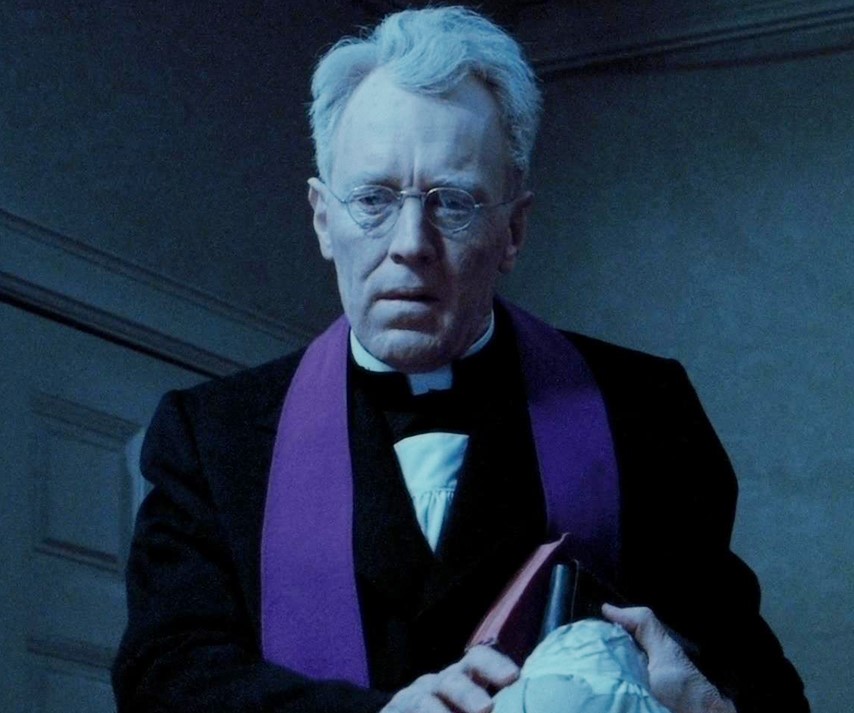
I did say that the decision to take a long time to set up the plot is a great thing for the most part. The slight negative criticism I have is that it does feel like the movie drags its feet a bit in getting to the point. The movie has a lot more side characters than it probably needs and by the time the mother has gone to the 10,000th doctor to figure out what's wrong with her daughter, you would think she would've got the point that the doctors aren't going to do anything, but the movie makes sure to drive that point home so that no one in the audience will forget that the doctors can't do anything. This unfortunately made it so that my eyes got a bit heavy during both viewings of the movie when it came to the first half of the film. I don't want to call it boring, but the second half of the movie is certainly a lot more interesting than the first half. But the wait certainly does pay off. When Jason Miller as Father Karras and Max von Sydow (who looks just as old in this film as he does in "The Force Awakens") as Father Merrin are both in the home performing the long exorcism on the girl, this is an extremely rewarding sequence. I'd go as far as saying this is the absolute best exorcism sequence that I've ever seen as all the emotions build to this intensely fascinating climax.

As far as a grade for this movie goes, I've been struggling with what to give this ever since I watched this last year for the first time. If I'm being honest, had I rushed in and reviewed this movie last year, I may have only wound up giving this a 7 or an 8, which is one of the main reasons why I knew I needed to give this more time. I thought that if I did give it time and get around to it this year instead, perhaps I'll come to see exactly why this is such a beloved film. And I will say that I have come to appreciate this film more in the last year. In watching it again yesterday, I certainly had a higher appreciation for the film and was able to give a better analysis of its fascinating themes. And I know what I'm SUPPOSED to say. I'm supposed to call this a flawless masterpiece. I'm supposed to say that this is one of the best, if not the best, horror film ever made and the Godfather of all demonic possession horror films. And I wanted to make that claim, but if I'm being honest with myself, I don't think I'm there yet. Could that change in 5-10 years after I've given myself even more time to mull it over in my head and pick up on all the details and character arcs? It's quite possible. But at this very moment in time, I think I can only get "The Exorcist" to a 9/10. Take that for what it's worth.

Tuesday, October 9, 2018

Retro Review: Hocus Pocus (1993)

Ever since I made the decision to do my Halloween reviews, the movie "Hocus Pocus" is a movie that I wanted to cover on this blog. I almost did it last year, but ran out of time. Lucky for me, when I asked for requests on Facebook for Halloween movies to review, both this year and last year I had at least one person ask me to review "Hocus Pocus." So, by popular demand, as well as the desire of my own heart, here we are reviewing "Hocus Pocus." However, unlucky for people who actually wanted me to review this, my reasons for reviewing it are most likely the exact opposite. Because as fun as it is to discuss Halloween classics that I love, it's also fun to go on rants about certain "classics" that I don't think deserve that label. So be careful what you wish for, I suppose. If you ask me to review a movie, I'm going to be obligated to give my personal opinion on it, which might be the exact opposite of yours. But that's OK, right? If we all had the same opinion on everything, life would be really boring. Shall we now proceed and talk about the critically panned, box office failure that is "Hocus Pocus" that I personally think should've never been given a second life, but somehow gained the status of a cult classic for reasons that I will never understand?

I could dive into the plot of "Hocus Pocus" if I wanted to. And usually this is where I do that. But you all know what happens. Three children-killing witches get resurrected in 1993 after having been dead for 300 years and wander around town on Halloween night making a fool out of themselves before getting stopped by three young kids because said witches are the most gullible beings to ever walk the face of the Earth. That's your movie in a nutshell. But before we explore why this is in fact a bad movie, let's discuss the history behind this because I find said history a bit fascinating. This is a movie that was released during the summer of 1993. Not Halloween season. The summer. It was released on the same weekend as "Free Willy," making $8.1 million that weekend, which was good enough for fourth place. Also in theaters at that time was "The Firm," "In the Line of Fire," "Jurassic Park," "Sleepless in Seattle" and "Rookie of the Year." For 1993 standards, the movie didn't hold on that well as it was deterred by mostly negative reviews. "Free Willy," which opened with less money at just $7.8 million, went on to make $77 million while "Hocus Pocus" could only manage $39 million, which was only good enough to be the 39th highest grossing movie that year.

For context and comparison, the 39th highest grossing movie of 2017 was "The Post" was $81 million. The highest grossing movie of 1993 was "Jurassic Park" with $357 million, followed by "Mrs. Doubtfire," "The Fugitive," "The Firm" and "Sleepless in Seattle." So no, this wasn't a win for Disney right off the bat. With a $28 million budget, a $39 million total wasn't a huge loss, but I'm sure they were hoping for a lot more right off the bat. As far as the negative reviews go, I don't know what the Rotten Tomatoes score would've been had Rotten Tomatoes existed back then, but the current score as of October 2018 is a mere 30 percent, and that's with old and new reviews combined. But as I'm sure you all know, the story doesn't end there. The movie gained a new life when it was released on VHS the next year. It consistently saw strong sales every single year, which I believe continues till today, and has been rebroadcast on ABC or Disney Channel every year since the mid-90's, with impressive view counts each time. That's what's made this movie such a classic. That's a lesson that, even if a movie fails in its initial theatrical run, the story is not necessarily over. The movie even got its own thing at Magic Kingdom in Disney World as a part of Mickey's Not-So-Scary Halloween Party.

For me all of this is a strange case of holiday nostalgia. Normal nostalgia is a very powerful thing sometimes, causes people to forgive or even praise bad movies because they enjoyed it when they were younger. Add in the holiday theme and that's a double whammy. Not only does it have the nostalgic vibes, but there's a holiday to propel it forward, which gives people a reason to consistently watch it or for television stations to consistently broadcast it when otherwise they might not have. This is also how "A Christmas Story" became so popular. Holiday nostalgia despite failing in its initial box office run. Also, sometimes movies with holiday themes are easy for people to forgive. A Halloween movie with enough scares or a Christmas movie with a nice message can help people overlook what can often be poor plot devices, underdeveloped characters and especially bad acting. Throw in some time to the equation, and heaven forbid anyone say anything bad about an older movie. I mean, trash newer movies like "Goosebumps" or "The House with a Clock in its Walls" all you want with all your nitpick complaints. That's easy. But don't you dare say anything bad about the 25-year-old "Hocus Pocus." That's the power of holiday nostalgia.

Perhaps a big reason why I'm not a fan of "Hocus Pocus" is because I don't have the advantage of nostalgia with this one. My parents never showed it to us and after watching the movie, I totally understand why. When did I first watch it? Well, that's a funny question. I have no idea. Maybe I saw it at a friend's house when I was a kid. Maybe I watched it at a Halloween party in High School. Maybe I wasn't exposed to it until college. The memory of my first "Hocus Pocus" viewing is simply not there and I think the reason for this is that every viewing that has happened has left me silently confused. I've never had fun with this movie. I've never been entertained or hardly even amused. But yet I've never been brave enough to say anything because everyone around me is having the time of their lives, so I just silently pretend that I'm enjoying myself along with them as to not ruin or spoil their Halloween celebrations. But now that I've been doing this movie critic thing on this blog since 2012, I've become increasingly more courageous is sharing my opinions of movies without really caring if said opinion upsets people or not. Granted, if a "Hocus Pocus" movie night is declared, I'll still do my best to not ruin people's celebrations, but now you'll know the truth.

So let's dive into specifics shall we? I'm not going to dissect every element of the movie, but I do want to start with the introduction. We're in 1693, during the height of the Salem Witch Trials, an extremely popular theme among Halloween movies. We are immediately introduced to three overly exaggerated witches, Winifred, Sarah and Mary Sanderson, who have the goal to achieve eternal youth. They want to stay young and beautiful forever. In order to do this, they have to suck the soul out of a young child. And poor little Emily happens to wander into their cabin in the woods and gets captured by these witches. They cast a spell on her, absorb her youth, and kill her. Immediately I'm like, wait what? Who made this movie and who is the target audience. Yes, Disney made this movie and they made it for kids as a "fun, family-friendly Halloween movie." And we start this by killing a young girl. But not just that, the three witches place a guilt trip on the girl's brother, blaming him for not saving his sister, and then transform him into an immortal cat so that he can live forever with his guilt. Then the three witches are captured by the townspeople and hanged, a fairly disturbing scene, but not before they cast a chant which gives them the opportunity to be resurrected.

I personally don't inherently have a problem with a somewhat disturbing horror movie set in the 1600's around the time of the Salem Witch Trials. One of my favorite horror movies is "The Witch," which is exactly that. And I also don't have an inherent problem with cheesy kids movies. If the movie is targeted at kids and they love it, then my opinion doesn't really matter and I can accept that, especially when said cheesy kids movie is a 90's movie. That's my wheelhouse. My problem is when you try to combine the two by making a cheesy kids movie that doubles as a disturbing horror film that ends up in an awkward position in that it is neither all that scary nor really appropriate for kids or fun for adults. I mean, the opening sequence is almost all I need to critique this movie. We kill a young girl. We turn a young boy into a cat for 300 years after sending him on a horrible guilt trip. Then we hang three witches. That's not really what I would qualify as "harmless, family-friendly entertaining." It's not harmless, nor is it family-friendly. It's a tonal mismatch coming from an era where Disney was trying to be more edgy with their films, earning them the conspiracy theory that Disney is secret trying to destroy kids with the films that they make.

After we make our way through this disturbing introduction, we have to wade through the often cringe-worthy main portion of the film. This has stereotypical bad 90's film written all over it, starting with a whole cast of characters who are poorly written and under-developed. Our main character is an annoying teenage boy that bounces back and forth between loving life and hating life, depending on what the script needed him to do in that scene. We have said boy's love interest in an attractive teenage girl, who does a great job in the movie, but I have a hard time believing that she would realistically associate with this boy with his sudden and awkward advances. Yet we have a horribly forced teenage love arc that makes no sense, but exists because the movie needed it. And is nothing but awkward and laughable every single step of the way. As side characters, we have parents of this boy who should win the award for worst and most negligent parents. And we have what I would be willing to declare the worst bullies ever portrayed in cinema with two teenage boys who can't act to save their life, yet somehow manage to be in half the movie anyways. And finally, we have our young girl, who out-performs and out-acts EVERY adult in the film.

The fact that I can only come up with one good character and good actor in this whole movie is rather embarrassing, especially since this character is played by the then 11-year-old Thora Birch. Bless her heart, she is so adorable and amazing, but she's dropped into a movie where nothing around her works. Thus despite her efforts, everything around her in this movie is miserable and frustrating. The plot is awful. The character progression isn't there. Most of the acting is atrocious. And the main three witches are pain-induces. Yes, I said it. They're awful. I will give credit to Bette Midler, Sarah Jessica Parker and Kathy Majimy as the Sanderson sisters in the fact that they look like they are having the time of their lives in this role. But all three of them are over-acting to the extreme and while some might find it funny and amusing, I find it extremely annoying. And while we're at it, Sarah Jessica Parker's character has extremely revealing cleavage for the entire movie. Normally I don't bother to point that out. But it's genuinely distracting. And this is a kid's movie, meaning her outfit is totally inappropriate. And speaking of inappropriate, this movie is extremely sexually promiscuous, loaded with dirty jokes not-so-subtly scattered throughout.

Yes, this is what I see every time I watch "Hocus Pocus." A disturbing introduction that I don't think is appropriate for kids. A cringe-worthy second act riddled with awful characters, horrible writing, terrible acting and lots of dirty humor because Disney was trying to be super edgy. I think this movie deserves a PG-13 rating, but somehow got away with PG because it's a family-targeted kids film from Disney. And the ending? Well, spoiler alert, our trio of kids, along with the 300-year-old boy turned into a cat and a zombie thing played by Doug Jones, stop the Sanderson sisters. But they do so mainly because our trio of witches is extremely gullible and keep falling for our main kid's tricks, which include spraying water that he says is deadly or shining the headlights of car into the window and saying it's daylight. As Deadpool would say, that's just bad writing. But are they dead for good? Because the book opens its eyes at the end right after it's revealed that no one bothered to free the two bullies. Sequel? I hope not, even though it's been rumored for a long time. How about we instead do a remake because this idea could work, but the execution is awful. Yet millions give it a pass because of holiday nostalgia. Well I'm not. I think this is a bad movie and I'm giving it a 4/10.